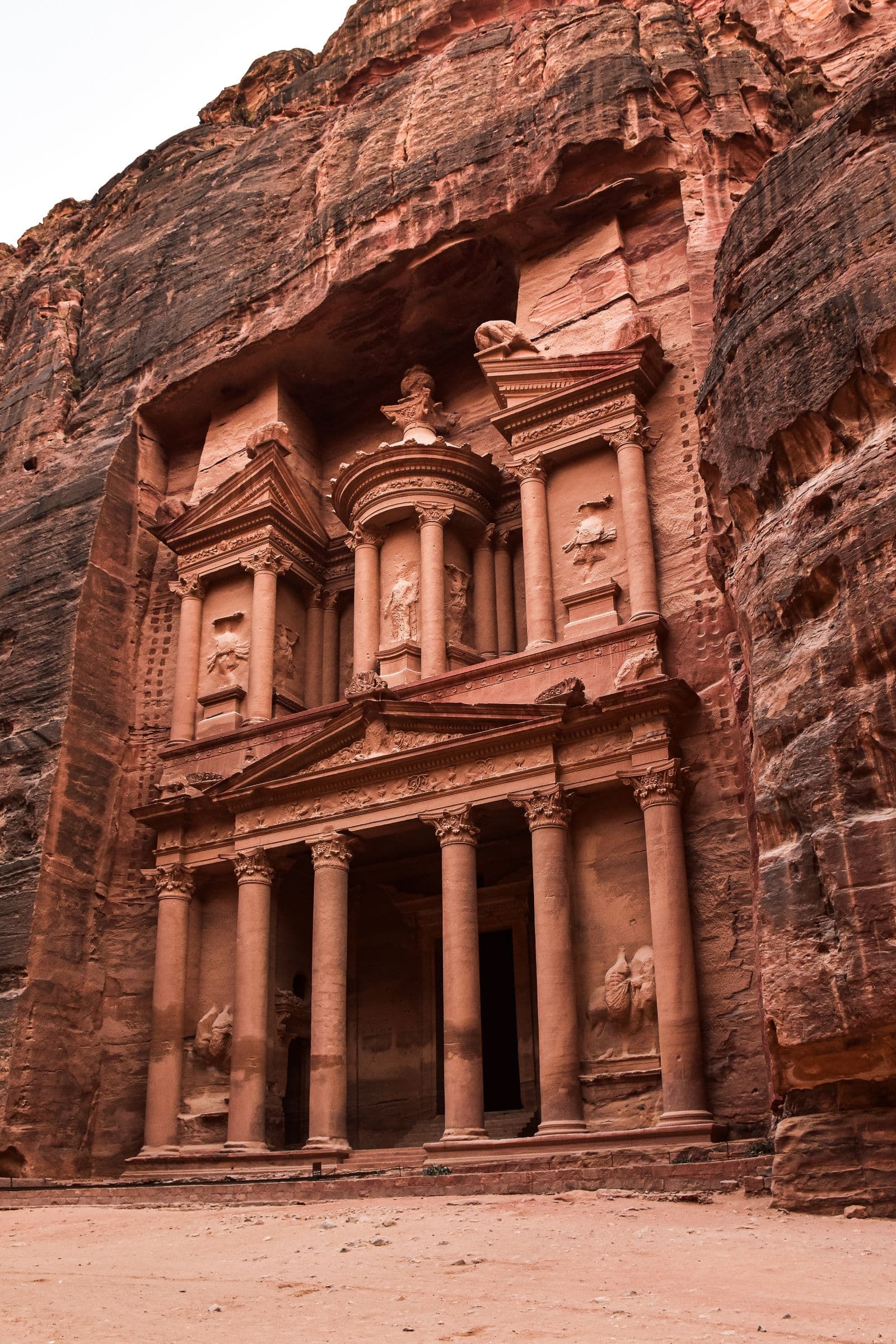
A desert people grew rich on the incense trade and carved their capital into rose-red cliffs. The building everyone calls the Treasury was never a treasury at all.
Two thousand years ago, the Nabataeans controlled the caravan routes that carried incense, myrrh and spices from Arabia to the Mediterranean. They grew rich, and they built their capital not out of stone, but into it — carving temples, tombs and halls into the soft, rose-coloured sandstone of southern Jordan.
The approach
You enter as travellers always have: through the Siq, a winding gorge more than a kilometre long, its walls so high that the sky narrows to a ribbon. At its end, the gorge opens onto Al-Khazneh, the Treasury — a facade of columns and statues cut straight out of the cliff.
“Local legend said the urn on its summit held a pharaoh's gold. It was almost certainly a royal tomb.”
The Nabataeans were also master engineers of water, channelling rare desert rain through cisterns and conduits to sustain a city of thousands. Petra declined after trade routes shifted, and was little known in Europe until the Swiss traveller Johann Ludwig Burckhardt reached it in 1812.
If you go
Enter at opening time to have the Siq almost to yourself, and save energy for the climb of around 800 steps to Ad Deir, the Monastery, which is larger than the Treasury and far quieter. Stay at least two days; Petra is a city, not a single monument.

About this story
Written for the WanderMate Journal by our team in Varanasi, where we plan and run journeys along the Ganga. We check facts against official and published sources, listed below, and revise guides when timings, prices or dates change.
Spotted something out of date? Tell us.