Banaras keeps its own hours, and so does its food: kachori at dawn, lassi at noon, chaat at dusk, paan at midnight and malaiyo only when the nights are cold. Here is the day, dish by dish, and how to eat it like someone who lives here.
The short answer
Varanasi eats by the clock. Start with kachori sabzi and hot jalebi, eaten before 10 AM. In winter, look for malaiyo, a saffron milk foam sold only on cold mornings. Drink lassi from a clay kulhad, eat tamatar chaat around Godowlia in the evening, and finish with a Banarasi paan, which has a GI tag. Almost all of it is vegetarian.
Key points
- Breakfast early: kachori sabzi and jalebi
- Chaat after 5 PM around Godowlia
- Malaiyo only on winter mornings
- Mostly vegetarian, often without onion or garlic
In Varanasi, food is a matter of timing. The kachori counters in the old city are crowded at seven in the morning and shuttered by eleven. The chaat shops of Godowlia light their stoves as the Aarti ends. The man with the brass pot of malaiyo appears on the corner only on cold mornings, and only until the sun warms the foam. Miss the hour and you miss the dish.
This is a city of pilgrims and priests, and its food reflects it: almost entirely vegetarian, often made without onion or garlic near the temples, rich with ghee, milk and sugar, and eaten standing up. Below is a day of eating in Banaras, from the first kachori to the last paan, with the names of the dishes you should ask for and the places locals send you.
The day at a glance
- 6–10 AM
- Eat or drinkKachori sabzi, jalebi, chai
- Where to lookKachori Gali and the lanes of Chowk and Thatheri Bazaar
- 7–10 AM (winter)
- Eat or drinkMalaiyo; choora matar
- Where to lookStreet vendors in the old city around Chowk and Godowlia
- Late morning to afternoon
- Eat or drinkLassi in a kulhad, thandai
- Where to lookLassi shops in the lanes near the ghats; Lanka near BHU
- 5–10 PM
- Eat or drinkTamatar chaat, palak patta chaat, golgappe
- Where to lookGodowlia and the road to Dashashwamedh
- Evening
- Eat or drinkBaati chokha, sweets: lal peda, launglata
- Where to lookSweet shops across the city
- After dinner
- Eat or drinkBanarasi paan
- Where to lookPaan counters on every main street
| Time | Eat or drink | Where to look |
|---|---|---|
| 6–10 AM | Kachori sabzi, jalebi, chai | Kachori Gali and the lanes of Chowk and Thatheri Bazaar |
| 7–10 AM (winter) | Malaiyo; choora matar | Street vendors in the old city around Chowk and Godowlia |
| Late morning to afternoon | Lassi in a kulhad, thandai | Lassi shops in the lanes near the ghats; Lanka near BHU |
| 5–10 PM | Tamatar chaat, palak patta chaat, golgappe | Godowlia and the road to Dashashwamedh |
| Evening | Baati chokha, sweets: lal peda, launglata | Sweet shops across the city |
| After dinner | Banarasi paan | Paan counters on every main street |
Morning: kachori, sabzi and jalebi
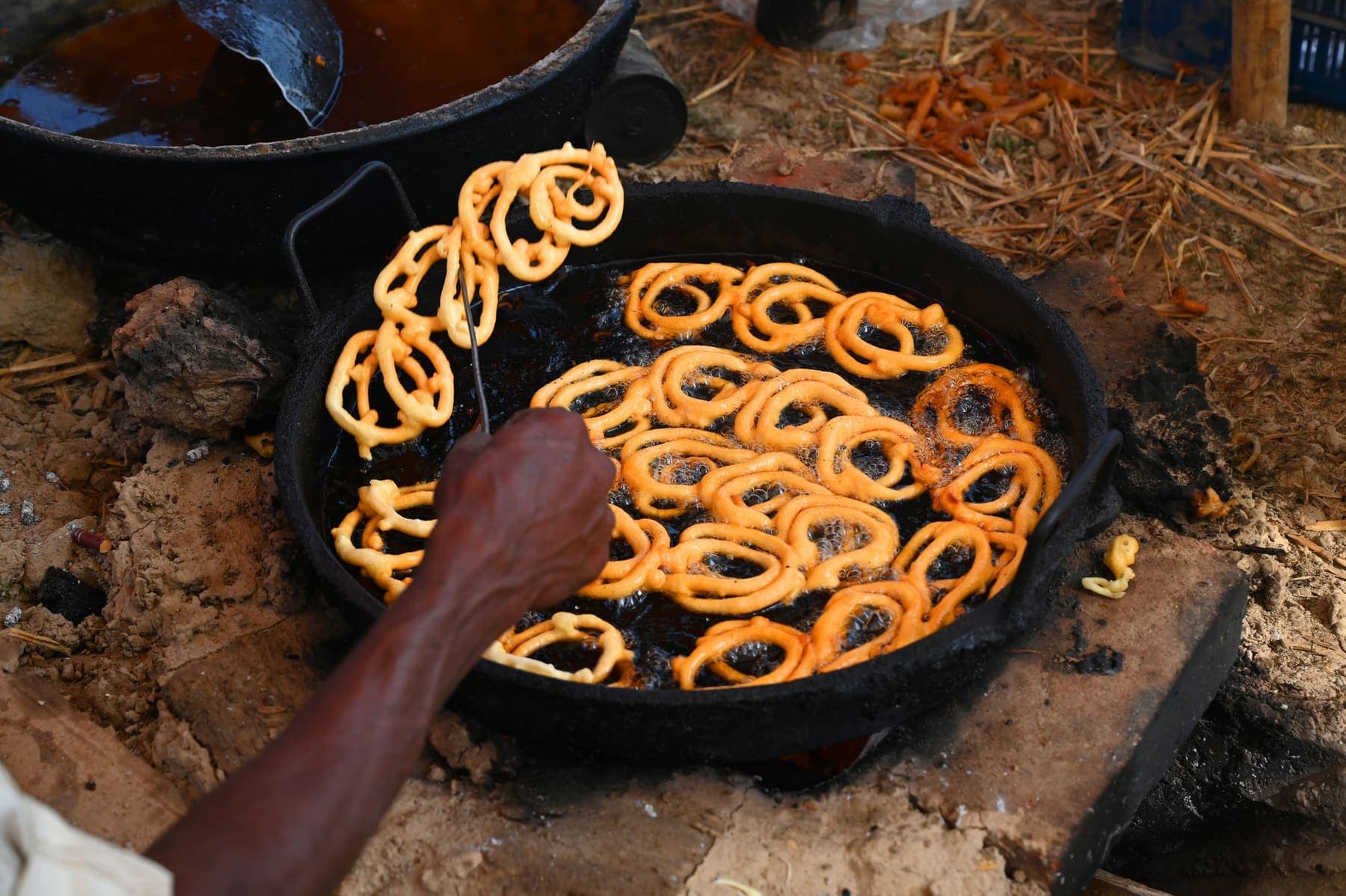
Banaras begins the day with kachori sabzi. The Banarasi kachori is not the round, stuffed pastry of Rajasthan: it is a small puffed bread, often filled with a thin layer of spiced lentil, fried in batches and served with a sharp, peppery curry of potato and sometimes pumpkin or chickpea. You eat it standing at the counter from a leaf plate, and then, because everyone does, you follow it with a hot jalebi, coiled straight from the oil into the syrup.
An entire lane near Chowk, known simply as Kachori Gali, has given itself over to the dish for generations, and the shops of Thatheri Bazaar nearby are just as famous; Ram Bhandar there is one of the best-known names in the city. Go early. By late morning the kachori is finished for the day and the counters are being washed down.
Winter mornings: malaiyo and choora matar
If you visit between about November and February, the most Banarasi thing you can eat is malaiyo. Milk is boiled, sweetened and left out overnight under the open winter sky; the dew, they say, is what gives it its lightness. At dawn it is churned by hand into a cloud of froth, scented with saffron and cardamom and scattered with pistachio, and served in a small clay cup. It tastes of almost nothing and of everything, and it dissolves the moment it touches your tongue.
Winter also brings choora matar, flattened rice tossed with fresh green peas, ghee, ginger and spices, a warm, savoury breakfast that appears with the new peas and disappears when they do.
Afternoon: lassi, thandai and the clay cup
Lassi in Varanasi is thick enough to eat with a spoon, crowned with a layer of clotted cream, malai, and served in a kulhad, an unglazed clay cup you break after drinking. The tiny lassi shops in the lanes above the ghats serve dozens of flavours, from banana and pomegranate to chocolate, and Blue Lassi, in the lanes near Manikarnika, is the best known to travellers. Near Banaras Hindu University, the lassi shops at Lanka are where students go. The plain sweet lassi is still the best.
Thandai is the city's festival drink: cold milk blended with almonds, fennel, rose, pepper and saffron. It is everywhere at Holi and Mahashivratri, sometimes with bhang, a preparation of cannabis that is sold legally from licensed government shops in Uttar Pradesh. If you are offered bhang thandai, know what you are drinking: it is far stronger than people expect and takes hours to wear off.
Evening: tamatar chaat and the chaat shops of Godowlia
As the light goes, the chaat shops around Godowlia and the road down to Dashashwamedh fill up. The dish to order is tamatar chaat, which you will not find outside Banaras: tomatoes and potatoes cooked down with ginger, green chilli and a secret mix of spices into a soft mash, served hot in a leaf bowl with a thin sweet syrup and a handful of crisp namkeen on top. Kashi Chaat Bhandar at Godowlia is the most famous place to try it, and it is crowded every evening.
- Palak patta chaat: whole spinach leaves fried crisp in gram-flour batter, topped with yoghurt and chutneys.
- Golgappe: hollow puris filled with spiced water, eaten in one bite; ask for the sweet and the sour waters.
- Aloo tikki: potato patties fried on a flat iron griddle until a crust forms, with chickpeas and chutney.
- Dahi chaat: crisp papdi under cool yoghurt, tamarind and mint.
“Eat breakfast early and chaat late. Banaras keeps its own hours.”
Sweets: lal peda, launglata and more
Varanasi's sweet shops are an institution. Lal peda, made from milk cooked slowly until it caramelises to a deep reddish brown, is the sweet families take home from Kashi. Launglata is a crisp parcel of pastry filled with khoya and sealed with a single clove, fried and dipped in syrup. Rabri, thickened milk with layers of cream, is eaten with jalebi or on its own. In summer, look for kulfi, and in late May and June the city's own Langda mango, which received a GI tag in 2023.
After dinner: Banarasi paan
End the night with a Banarasi paan: a betel leaf, here usually the soft Maghai leaf, folded around slaked lime, catechu, areca nut and sweet, fragrant fillings such as gulkand and fennel, and pinned with a clove. The craft of paan in the city is old enough to have its own songs, and in 2023 Banarasi paan was given a Geographical Indication tag. Ask for a meetha paan, a sweet one, if it is your first; you chew it slowly and do not swallow the whole thing at once.
How to eat street food safely
- 1Eat where it is busy. A crowd means the food is fresh and turning over fast.
- 2Choose it hot. Food fried or boiled in front of you is safest; be more careful with cut fruit and chutneys left out in the heat.
- 3Mind the water. Golgappe water is the riskiest dish on the street; if your stomach is new to India, try it later in the trip.
- 4Carry small notes. Many stalls take UPI, but cash is still easiest for a few kachoris.
- 5Go slowly. The best way to eat in Banaras is a little, often, over several days.
Eating your way through a stay
Food fits naturally into the rhythm of a visit: kachori after a sunrise boat ride, lassi in the lanes after Kashi Vishwanath, chaat after the Ganga Aarti. If you are coming in winter, plan at least one early morning for malaiyo; our guide to the best time to visit Varanasi explains when it is in season.
On Banaras Unfiltered and Kashi in Four Days, a food walk through the old city with someone who grew up eating there is part of the journey.
Questions people ask
- What is the most famous food in Varanasi?
- Kachori sabzi with jalebi for breakfast, tamatar chaat in the evening, lassi in a clay cup and Banarasi paan. In winter, malaiyo.
- When can you get malaiyo in Varanasi?
- Only on cold winter mornings, roughly November to February. It is sold early and is gone by about 10 AM.
- Where can I eat tamatar chaat in Varanasi?
- Around Godowlia in the evening; Kashi Chaat Bhandar at Godowlia is the best-known shop and is busy every night.
- Is Varanasi street food vegetarian?
- Almost entirely. Much of it near the temples is also made without onion or garlic.
- Is Banarasi paan GI-tagged?
- Yes. Banarasi paan received a Geographical Indication tag in 2023, along with the Banarasi Langda mango.

About this guide
Written for the WanderMate Journal by our team in Varanasi, where we plan and run journeys along the Ganga. We check facts against official and published sources, listed below, and revise guides when timings, prices or dates change. Last updated 14 October 2026.
Spotted something out of date? Tell us.
Sources