Every evening at Dashashwamedh, a row of young priests raises great tiered lamps to the river. How to time it, where to sit, what each part of the ritual means, and when Assi is the better choice.
The short answer
The evening Ganga Aarti at Dashashwamedh Ghat begins shortly after sunset, at about 6 PM from October to March and about 7 PM from April to September, and lasts around 45 minutes. Arrive 45 to 90 minutes early for a place on the steps, or watch from a boat in front of the ghat. At dawn, Assi Ghat holds Subah-e-Banaras, a gentler morning Aarti with music and yoga.
Key points
- Evening Aarti: about 6 PM in winter, 7 PM in summer
- Lasts about 45 minutes; arrive an hour early
- Boat for the full view, steps for the sound
- Dawn Aarti at Assi: Subah-e-Banaras
Aarti is one of the oldest gestures of Hindu worship: a flame waved in slow circles before the divine, as an offering of light. In a temple it is offered to an image. On the ghats of Varanasi it is offered to the river itself, to Ganga, who is worshipped as a goddess and a mother, and it has become the best-known ritual in India. Every evening, whatever the season, a line of priests faces the water at Dashashwamedh Ghat and performs it while thousands watch from the steps and the boats.
If you see one thing in Varanasi, most people will tell you, see this. This guide covers when it starts through the year, what is happening at each stage, where to sit, and the quieter morning ceremony at Assi Ghat.
Ganga Aarti timings through the year
The Aarti is set by the sun, not the clock. It begins shortly after sunset, so its start moves through the year by about an hour. It lasts around 45 minutes, longer on festival days.
- November to January
- SunsetAbout 5:10–5:30 PM
- Aarti beginsAbout 6:00 PM
- Arrive by5:00 PM
- February and October
- SunsetAbout 5:30–6:00 PM
- Aarti beginsAbout 6:15–6:30 PM
- Arrive by5:15 PM
- March and September
- SunsetAbout 6:00–6:15 PM
- Aarti beginsAbout 6:30–6:45 PM
- Arrive by5:45 PM
- April to August
- SunsetAbout 6:20–6:50 PM
- Aarti beginsAbout 7:00 PM
- Arrive by6:00 PM
| Months | Sunset | Aarti begins | Arrive by |
|---|---|---|---|
| November to January | About 5:10–5:30 PM | About 6:00 PM | 5:00 PM |
| February and October | About 5:30–6:00 PM | About 6:15–6:30 PM | 5:15 PM |
| March and September | About 6:00–6:15 PM | About 6:30–6:45 PM | 5:45 PM |
| April to August | About 6:20–6:50 PM | About 7:00 PM | 6:00 PM |
Approximate; the organisers adjust the time through the year. On festival days, especially Dev Deepawali, Diwali and Kartik Purnima, the Aarti is grander and the ghat fills from early afternoon. In the monsoon it may move to higher steps or a rooftop.
What happens, step by step
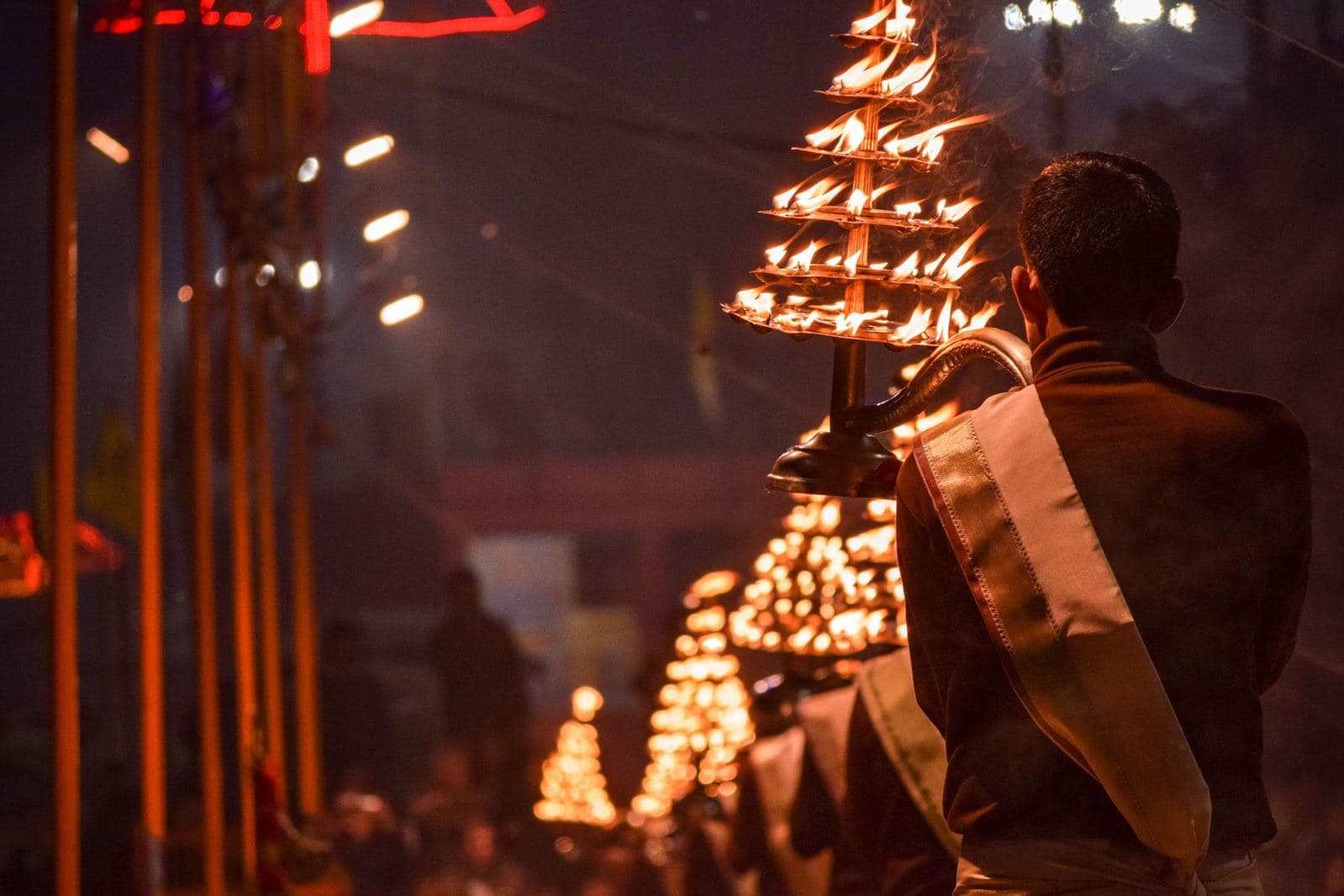
Seven young priests in saffron and silk take their places on raised wooden platforms at the water's edge, each with a tray of ritual objects. Behind them, the ghat is hung with lights and bells. They move together, facing the river, to the sound of bells, drums, conch shells and devotional song played over loudspeakers. Each stage offers something to the river, as a guest would be honoured in a home.
- 1The conch is blown to open the ceremony and call the river's attention.
- 2Incense is offered first, its smoke drawn in wide arcs over the water.
- 3The great lamps: heavy brass stands with many tiers of flame are lifted and turned, so that the fire seems to pour through the dusk. This is the moment in the photographs.
- 4The single-flame lamp and the camphor, burnt with a bright white flame.
- 5The yak-tail whisk and the peacock-feather fan, waved as for royalty.
- 6Flowers and water are offered to the river, and the Aarti closes with the song to Ganga.
“The offering is not made to the crowd on the steps. It is made to the river; the crowd is simply allowed to watch.”
The evening Aarti at Dashashwamedh is organised by local trusts, the best known of which is the Ganga Seva Nidhi, and is funded largely by donations. It has grown greatly in scale over the last three decades, but the ritual itself, the lamp waved for the river at dusk, is as old as worship on these banks.
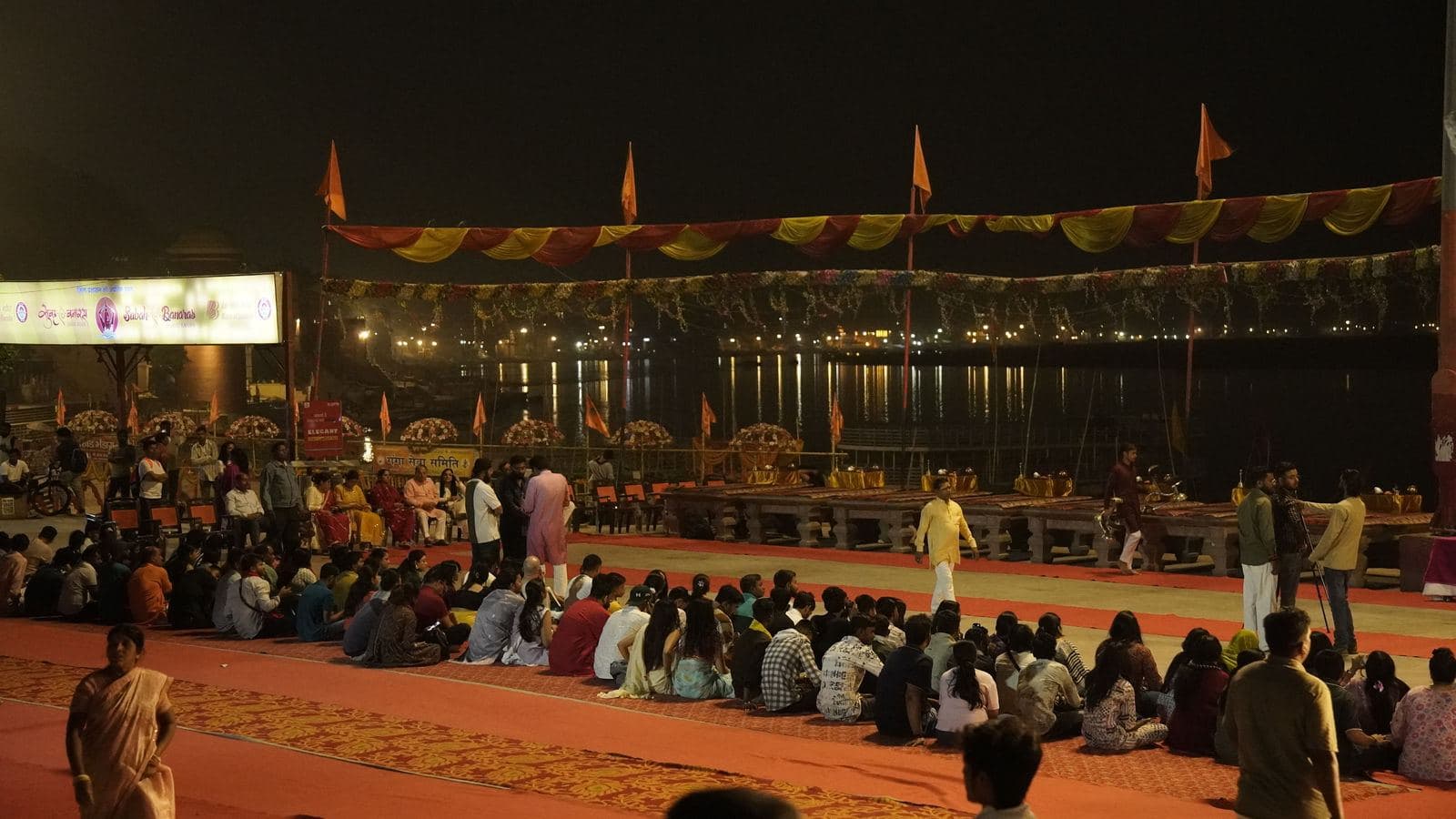
Where to sit: steps, boat or platform
- The steps of Dashashwamedh
- Best forThe sound, the heat of the lamps and the crowd of devotees
- Know thisThe best places go 45 to 90 minutes before the start
- A boat in front of the ghat
- Best forThe whole line of priests and the lamps reflected in the water
- Know thisAgree the price and the time before you step in
- Raised seats beside the platforms
- Best forA close view without the crush
- Know thisLimited; usually arranged through a guide or hotel
| Where | Best for | Know this |
|---|---|---|
| The steps of Dashashwamedh | The sound, the heat of the lamps and the crowd of devotees | The best places go 45 to 90 minutes before the start |
| A boat in front of the ghat | The whole line of priests and the lamps reflected in the water | Agree the price and the time before you step in |
| Raised seats beside the platforms | A close view without the crush | Limited; usually arranged through a guide or hotel |
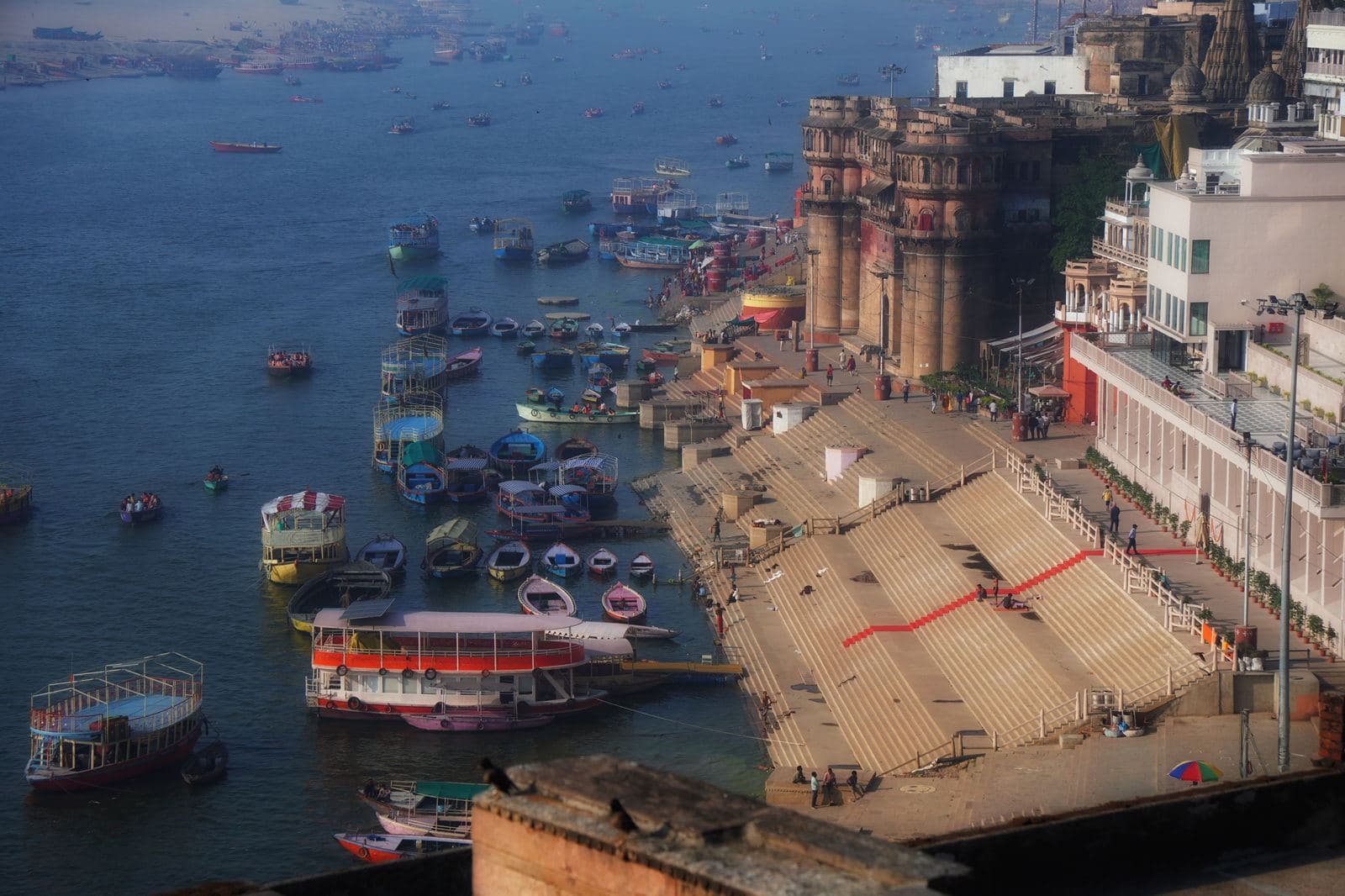
From the steps you are close enough to feel the warmth of the lamps, among families who come every week. From a boat, moored with dozens of others in front of the ghat, you see the full sweep of the ceremony and the lit city behind it, and you are spared the crowd. Boatmen on the ghats sell places on shared boats for the Aarti; prices are higher at weekends and in the festival season, so agree the fare first.
Dashashwamedh or Assi?
Dashashwamedh, near the centre of the riverfront, is named for the ten-horse sacrifice that Brahma is said to have performed there, and it holds the grand evening Aarti. Assi Ghat, at the southern end where the Assi stream meets the Ganga, has a smaller evening Aarti and is best known for its morning.
Subah-e-Banaras, the morning of Banaras, began in 2014. Every day before sunrise, the ghat holds a morning Aarti, Vedic chanting and a fire ritual, then live classical music and an open-air yoga session, about two hours in all. It starts around 45 minutes before sunrise, so at about 5 AM in summer and nearer 6 AM in winter. It is calmer than the evening, and the light coming up over the far bank is the most beautiful of the day.
- When
- Dashashwamedh (evening)After sunset, about 45 minutes
- Assi (Subah-e-Banaras)Before sunrise, about 2 hours
- Scale
- Dashashwamedh (evening)Grand; seven priests, large crowds
- Assi (Subah-e-Banaras)Smaller and calmer
- What you hear
- Dashashwamedh (evening)Bells, conch, devotional song
- Assi (Subah-e-Banaras)Chanting, then classical music
- Best view
- Dashashwamedh (evening)From a boat
- Assi (Subah-e-Banaras)From the steps
| Dashashwamedh (evening) | Assi (Subah-e-Banaras) | |
|---|---|---|
| When | After sunset, about 45 minutes | Before sunrise, about 2 hours |
| Scale | Grand; seven priests, large crowds | Smaller and calmer |
| What you hear | Bells, conch, devotional song | Chanting, then classical music |
| Best view | From a boat | From the steps |
Etiquette and practical tips
- Dress modestly and take off your shoes if you sit on the upper platforms where devotees do.
- Photograph quietly. Photography is allowed from the steps and the boats, but no flash, and put the phone down for a few minutes; the Aarti is a prayer, not a show.
- Keep your belongings close. The crowd is dense and pickpockets work the steps on busy nights.
- Offer a lamp. Afterwards, buy a leaf-cup diya with flowers from the children on the steps and set it on the river.
- Give only if you wish. You may be asked for donations; the Aarti is free to watch.
- Leave slowly. The lanes back to Godowlia are packed for half an hour after the end.

For the bigger picture, read our story on what the Ganga Aarti means, and if you are coming in November, our guide to Dev Deepawali, when the Aarti is at its grandest. On Banaras Unfiltered and Kashi in Four Days we watch it from the river.
Questions people ask
- What time is the Ganga Aarti in Varanasi?
- Shortly after sunset: about 6 PM from October to March and about 7 PM from April to September. It lasts around 45 minutes.
- Which ghat has the best Ganga Aarti?
- Dashashwamedh holds the grandest evening Aarti, with seven priests. Assi Ghat is quieter and known for Subah-e-Banaras, the morning Aarti with music and yoga.
- How early should I arrive for the Ganga Aarti?
- 45 to 90 minutes before the start for a good place on the steps; from early afternoon on festival days.
- Is it better to watch the Ganga Aarti from a boat?
- A boat gives you the whole line of priests and the reflections without the crowd; the steps put you closer to the sound and the people. Both are worth doing.
- What time is the morning Aarti at Assi Ghat?
- Subah-e-Banaras starts about 45 minutes before sunrise, around 5 AM in summer and nearer 6 AM in winter, and lasts about two hours.

About this guide
Written for the WanderMate Journal by our team in Varanasi, where we plan and run journeys along the Ganga. We check facts against official and published sources, listed below, and revise guides when timings, prices or dates change. Last updated 14 October 2026.
Spotted something out of date? Tell us.
Sources