For five days each autumn, Kolkata becomes one long, sleepless walk from pandal to pandal, to the beat of the dhak. What happens on each day, where the old pujas and the great theme pandals are, and how to see it without spending the night in a queue.
The short answer
Durga Puja 2026 in Kolkata runs from Maha Shashthi on Saturday 17 October to Bijoya Dashami on Wednesday 21 October, when Sindoor Khela is played and the idols are taken for immersion. Ashtami, the most sacred day, is 19 October. Go pandal hopping on Shashthi or Saptami, late at night or early in the morning, and use the Metro, which runs through the night.
Key points
- Shashthi 17 Oct to Bijoya Dashami 21 Oct
- Ashtami, the holiest day, is Monday 19 Oct
- Go out early in the week, late at night
- UNESCO intangible heritage since 2021
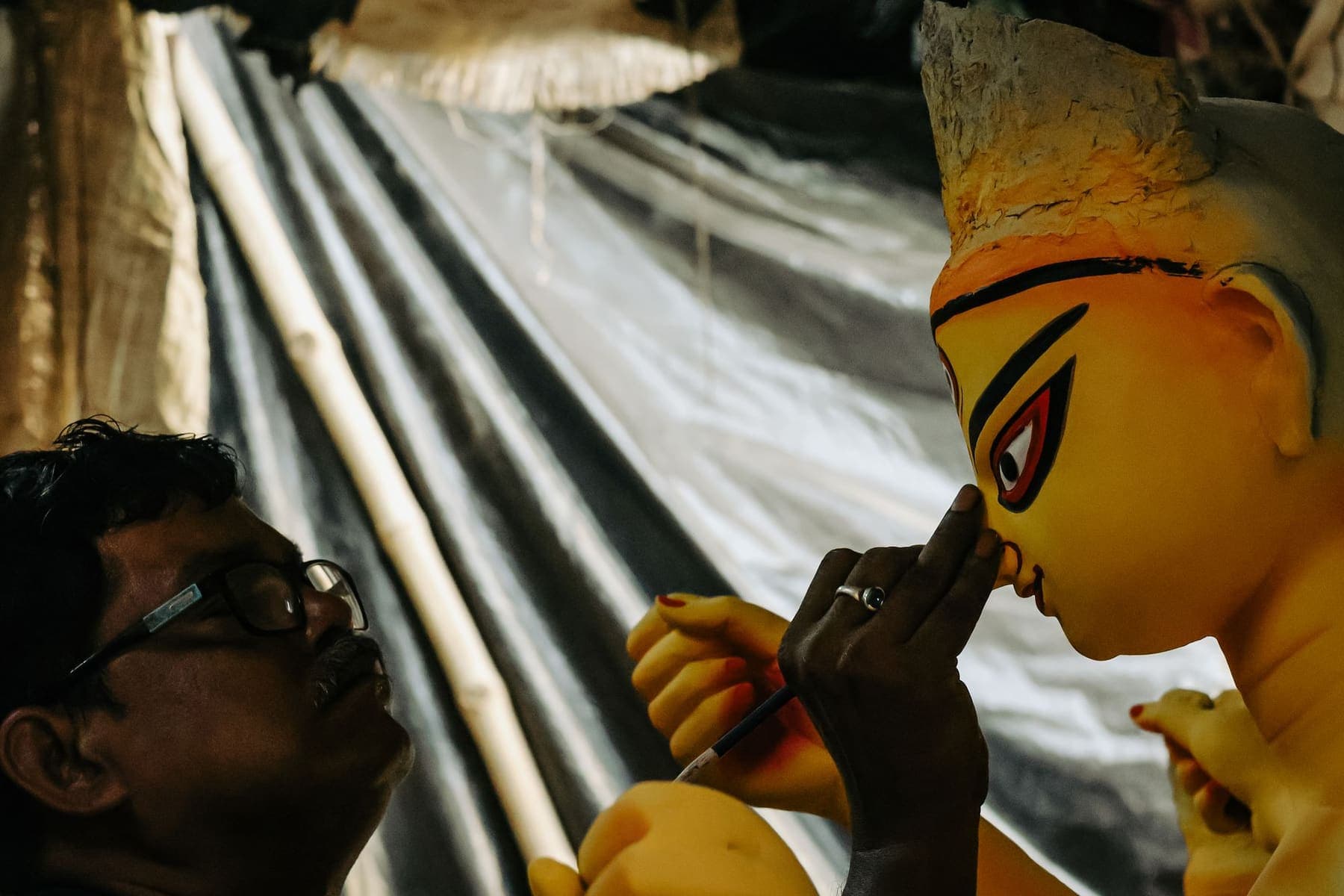
In Kolkata they do not call it a festival; they call it Pujo, and for five days every autumn it is the only thing that happens. Thousands of temporary shrines, the pandals, rise on street corners, in parks and between apartment blocks, each housing a clay image of the goddess Durga slaying the buffalo demon Mahishasura. The whole city goes out, all night, every night, walking from one to the next to the beat of the dhak drum, eating as it goes.
In 2021 UNESCO inscribed Durga Puja in Kolkata on its list of the Intangible Cultural Heritage of Humanity, describing it as the finest example of a public performance of religion and art. This guide explains the dates for 2026, what each day means, which pujas to see and how to move around a city that, for a week, never sleeps.
Durga Puja 2026 dates
The festival follows the lunar calendar, and the Bengali panjika and pan-Indian calendars sometimes count a tithi on different days, so you will see small disagreements online. The dates below are those given for Kolkata by most Bengali almanacs for 2026.
- Mahalaya
- DateSaturday 10 October
- What happensThe goddess is invoked at dawn; offerings to ancestors at the river. The countdown begins
- Maha Shashthi
- DateSaturday 17 October
- What happensThe goddess is unveiled in the pandals in the evening
- Maha Saptami
- DateSunday 18 October
- What happensThe kola bou is bathed in the Ganga at dawn; the puja proper begins
- Maha Ashtami
- DateMonday 19 October
- What happensPushpanjali in the morning, Kumari Puja, and Sandhi Puja at the turn of Ashtami and Navami
- Maha Navami
- DateTuesday 20 October
- What happensFeasting and the last full night of pandal hopping
- Bijoya Dashami
- DateWednesday 21 October
- What happensSindoor Khela, then processions to the river for immersion
| Day | Date | What happens |
|---|---|---|
| Mahalaya | Saturday 10 October | The goddess is invoked at dawn; offerings to ancestors at the river. The countdown begins |
| Maha Shashthi | Saturday 17 October | The goddess is unveiled in the pandals in the evening |
| Maha Saptami | Sunday 18 October | The kola bou is bathed in the Ganga at dawn; the puja proper begins |
| Maha Ashtami | Monday 19 October | Pushpanjali in the morning, Kumari Puja, and Sandhi Puja at the turn of Ashtami and Navami |
| Maha Navami | Tuesday 20 October | Feasting and the last full night of pandal hopping |
| Bijoya Dashami | Wednesday 21 October | Sindoor Khela, then processions to the river for immersion |
Dates for Kolkata per the Bengali calendar; some all-India calendars give Vijayadashami as 20 October. Confirm tithi timings with a panjika or your puja committee.
How Kolkata's Pujo began
Durga Puja in Bengal began as a festival of landlords and kings. The puja of the royal house of Krishnanagar is among the earliest on record, and in Kolkata the best-known early puja is that of Nabakrishna Deb at Sovabazar Rajbari, begun in 1757, the year of the Battle of Plassey, and held, it is said, partly in honour of Robert Clive. For more than a century, the great family pujas in the courtyards of north Kolkata's mansions were the centre of the festival.
The change came in 1790, when twelve friends in Guptipara, in Hooghly, pooled their money for a puja of their own. Their baroyari, or twelve-friends puja, became the model for the sarbojanin, the community puja open to all. The first in Kolkata was held in Bhowanipore around 1910, and within a few decades community pujas had overtaken the family ones. Today there are several thousand in the city, and the biggest are among the most-visited public events in the world.
The rituals, day by day
Saptami: the banana-plant bride
Before dawn on Saptami, priests carry a banana plant wrapped in a red-bordered saree to the river, bathe it and bring it back to stand beside Ganesh. This is the kola bou, often called Ganesh's bride, though she represents the goddess in the form of nine plants, the nabapatrika. The bathing ghats along the Hooghly are a beautiful place to be at sunrise that morning.
Ashtami: the most sacred day
On Ashtami morning, families in new clothes crowd the pandals to offer pushpanjali, flowers given to the goddess in three rounds while the priest chants. Some pujas hold Kumari Puja, the worship of a young girl as the living goddess. Then comes Sandhi Puja, at the precise junction of Ashtami and Navami, said to be the moment Durga killed the demons Chanda and Munda; it is performed with 108 lamps and 108 lotuses and lasts about 48 minutes. In 2026 it falls on the night of 19 to 20 October; each puja announces its exact time.
Dashami: Sindoor Khela and farewell
On Bijoya Dashami, married women offer sweets and vermilion to the goddess and then smear one another's faces and hair with it in Sindoor Khela, a joyous, tearful farewell. The idols are then lifted onto lorries and carried, with drums and dancing, to the river for immersion. That evening, families visit one another to say Shubho Bijoya and share sweets.
“Pick one neighbourhood a night and walk it. Kolkata's Pujo is best on foot.”
Which pandals to see
The pujas fall into two worlds, and the best visits include both: the traditional pujas of north Kolkata, where the goddess still looks as she did a century ago, and the theme pandals of the south and the new suburbs, where artists build entire worlds out of bamboo, cloth and light.
- North: Bagbazar and Kumartuli
- Pujas to seeBagbazar Sarbojanin, Kumartuli Park, Ahiritola
- WhyTraditional images, the river close by, the potters' quarter
- North: the old houses
- Pujas to seeSovabazar Rajbari and other bonedi bari (family) pujas
- WhyThe festival as it was in the eighteenth and nineteenth centuries
- Central
- Pujas to seeCollege Square, Mohammad Ali Park, Santosh Mitra Square
- WhyHuge crowds, lights on the lake, elaborate pandals
- South
- Pujas to seeSuruchi Sangha, Ekdalia Evergreen, Singhi Park, Tridhara
- WhyCelebrated theme pandals and designer idols
- North-east
- Pujas to seeDum Dum Park Tarun Sangha and its neighbours
- WhySome of the most inventive art pujas in the city
| Area | Pujas to see | Why |
|---|---|---|
| North: Bagbazar and Kumartuli | Bagbazar Sarbojanin, Kumartuli Park, Ahiritola | Traditional images, the river close by, the potters' quarter |
| North: the old houses | Sovabazar Rajbari and other bonedi bari (family) pujas | The festival as it was in the eighteenth and nineteenth centuries |
| Central | College Square, Mohammad Ali Park, Santosh Mitra Square | Huge crowds, lights on the lake, elaborate pandals |
| South | Suruchi Sangha, Ekdalia Evergreen, Singhi Park, Tridhara | Celebrated theme pandals and designer idols |
| North-east | Dum Dum Park Tarun Sangha and its neighbours | Some of the most inventive art pujas in the city |
Themes change every year and are revealed only on the opening days; local newspapers publish maps and award lists during the festival.
How to go pandal hopping
- 1Start early in the week. Panchami, Shashthi and Saptami are calmer; by Ashtami the famous pandals have queues of hours.
- 2Go late or go early. The city stays out all night. Between 2 and 6 AM, or in the morning, the queues are shortest.
- 3Take the Metro. Kolkata Metro runs extended and overnight services during the Pujo; in 2025 several lines ran until about 4 AM on the main nights. Check the 2026 schedule.
- 4Pick one area a night. North one night, south the next. Roads around the big pandals are closed to traffic, and you will walk a great deal.
- 5Eat on the way. Pujo is also a food festival: kathi rolls, fish fry, phuchka and mishti doi from stalls outside every pandal, and bhog, the khichuri offered to the goddess, served at many pujas.
Where to watch the immersion
From Dashami evening and through the following days, processions carry the idols to the Hooghly. Bagbazar Ghat and Babughat are the best-known places to watch, and the Red Road carnival, a parade of the city's prize-winning pujas, is held a few days later. It is a noisy, moving farewell; keep to the edges, follow police directions and stay away from the water's edge.
Before you go
- Book early. Hotels in central and south Kolkata fill months ahead for Pujo week.
- Dress for heat and crowds. October is still warm and humid; wear comfortable shoes and keep valuables to a minimum.
- Dress modestly for the family pujas, and ask before photographing inside a home.
- Carry water and small notes, and keep your phone charged; mobile networks are overloaded at night.
Kolkata is a natural pair with Varanasi: both are cities on the Ganga, and Pujo in October is followed in Kashi by Dev Deepawali in November. We plan private journeys to Kolkata on request, from Pujo itself to the city's colonial and literary past.
Questions people ask
- When is Durga Puja 2026 in Kolkata?
- From Maha Shashthi on Saturday 17 October to Bijoya Dashami on Wednesday 21 October 2026. Mahalaya was on 10 October.
- Which is the best day to see Durga Puja pandals?
- Shashthi or Saptami, before the Ashtami crowds. On any day, late night after 2 AM and early morning are the calmest times.
- When is Sindoor Khela in 2026?
- On Bijoya Dashami, Wednesday 21 October 2026, before the idols are taken for immersion.
- What is Sandhi Puja?
- A 48-minute ritual at the junction of Ashtami and Navami, performed with 108 lamps and 108 lotuses. In 2026 it falls on the night of 19 to 20 October.
- Is Durga Puja a UNESCO heritage?
- Yes. Durga Puja in Kolkata was added to UNESCO's Representative List of the Intangible Cultural Heritage of Humanity in 2021.

About this story
Written for the WanderMate Journal by our team in Varanasi, where we plan and run journeys along the Ganga. We check facts against official and published sources, listed below, and revise guides when timings, prices or dates change. Last updated 14 October 2026.
Spotted something out of date? Tell us.
Sources